
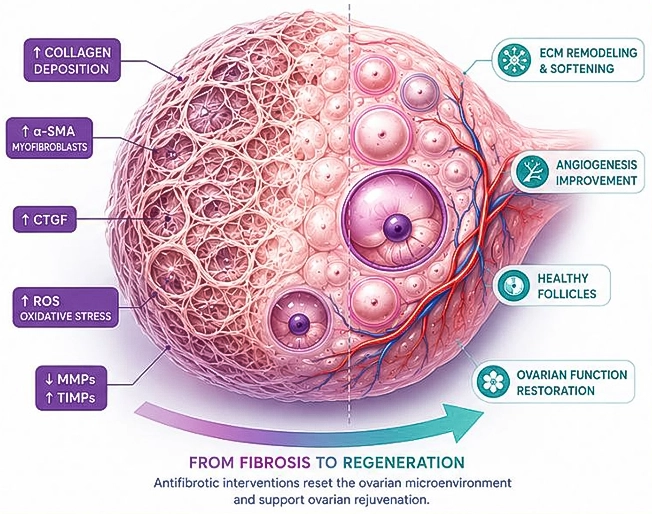
Why do ovaries lose function with age?
The ovaries begin to lose their full functional capacity already around the age of 30, with a more pronounced decline after the age of 45. While the causes are multifactorial, three key processes occur silently within ovarian tissue:
Accumulation of fibrotic (scar-like) tissue.
Over time, due to repeated ovulations and low-grade inflammatory processes, dense connective tissue gradually forms within the ovaries — like microscopic scarring. This tissue mechanically compresses follicles (the structures where oocytes mature) and interferes with their normal growth and development.
Persistence of aged and damaged cells.
Healthy cells either regenerate or undergo programmed death when their lifespan ends. However, some cells become “stuck” — they no longer function properly, but they also do not die. These senescent cells release harmful substances that accelerate aging of the surrounding tissue and disrupt hormonal balance within the ovary.
Decline in cellular energy production.
Each cell contains mitochondria — organelles responsible for energy production. Oocytes require exceptionally high energy levels for maturation and early embryo development. With age, mitochondrial function declines, leading to reduced energy availability. This is a key reason why oocyte quality decreases over time, regardless of hormonal stimulation.
The good news: modern science can now target all three of these processes through tailored molecular pharmacotherapy.
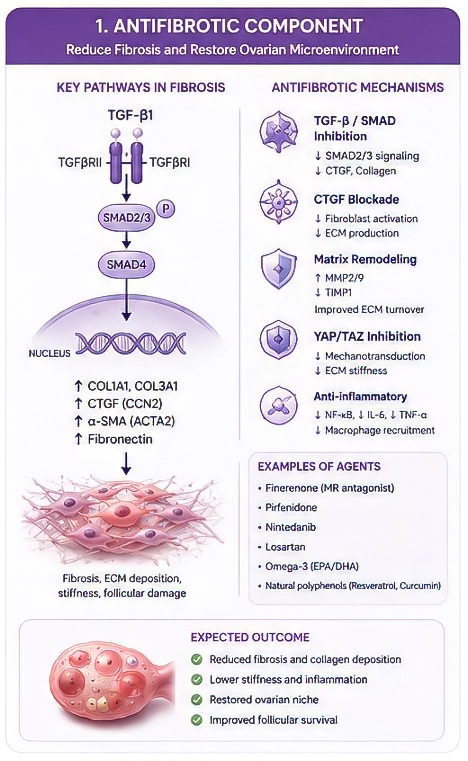
Certain medications can actively reduce the formation of connective tissue within the ovary and promote its gradual remodeling. Among them is finerenone — a drug widely used in the treatment of kidney disease, which has recently shown promising results in ovarian rejuvenation.
In a study published in February 2026 in the prestigious journal Science, 14 women with premature ovarian insufficiency received oral finerenone over several months. All participants developed follicular growth, and 7 of them produced mature oocytes suitable for IVF, from which embryos were created. These represent the first human data (following preclinical and animal studies) suggesting that targeting fibrotic tissue can help restore ovarian function.
Other antifibrotic agents used in pulmonary medicine (pirfenidone, nintedanib) have demonstrated, in animal studies, the ability to reduce ovarian fibrosis, increase follicle numbers, and improve hormonal profiles. Natural compounds such as quercetin and resveratrol act on similar pathways, although with milder and slower effects.
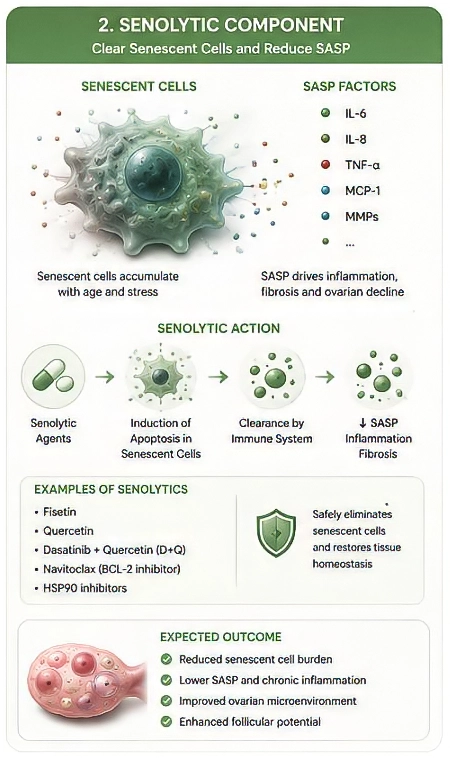
A specific class of compounds known as senolytics — literally “cleaners of aged cells” — can selectively target and eliminate senescent cells, clearing space for healthy, functional cells.
The most studied combination is dasatinib and quercetin. In animal studies, this combination reduced the number of senescent cells in the ovary, restored follicular reserve, and improved fertility outcomes. More recent research suggests that delivering these compounds via nanoparticle systems may further enhance their effectiveness.
In humans, these agents have already been studied in other conditions (such as bone and kidney diseases), while ovarian-specific clinical studies are ongoing.
Senolytics are not taken continuously — they are administered intermittently (e.g., a few days per month), which helps minimize side effects. Rapamycin, another related agent, does not eliminate senescent cells but suppresses their harmful secretory activity.
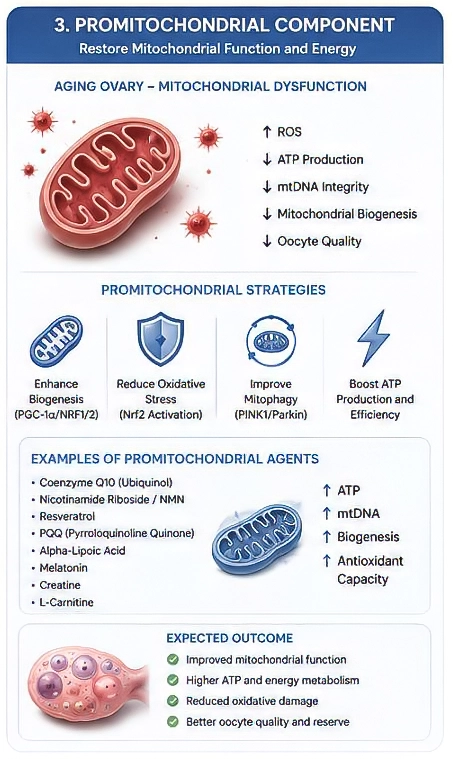
Coenzyme Q10 (CoQ10) is a widely used supplement that supports mitochondrial function — the “energy batteries” of the cell. Studies involving more than 1,500 women with diminished ovarian reserve have shown that women taking CoQ10 prior to IVF had a higher number of retrieved oocytes, improved embryo quality, and higher pregnancy rates.
NMN and NR are supplements that increase levels of NAD+, a key molecule involved in cellular energy metabolism that declines with age. Animal studies show that these compounds improve oocyte quality, increase follicle numbers, and extend reproductive lifespan. In 2025, an initial human analysis in women with diminished ovarian reserve suggested larger follicles, improved endometrial thickness, and a twofold increase in pregnancy rates — although larger, controlled studies are still needed.
Alpha-lipoic acid, L-carnitine, and other mitochondrial-supporting supplements may also be included as part of an individualized treatment protocol, depending on your clinical findings and needs.

Important note:
All described therapies are currently in different stages of clinical research. Their use should be strictly supervised by a physician and tailored individually. This document is intended for informational purposes and does not replace medical consultation.
Contact our team to learn more about how we can assist you.